

Rhythm at Work · The Dr. Ludidi Method for organisations
Your team is running on empty. Energy is a rhythm problem, and rhythm can be fixed.
An 8-week energy programme for teams, on company time, at a fixed price, reported at group level. Developed with CBS, Philips, Maxion Wheels and Máxima MC.
Het programma draait in het Nederlands. Een Nederlandse versie van deze pagina volgt.
Book a 30-minute call
Read the CBS results ↓
01
What we see
Four moments of the day. One problem.
07:00
Waking up already tired
15:00
The 3pm slump
19:00
Nothing left for yourself
Over time
Colleagues dropping out
These are not four problems. They are one problem, recovery debt, showing up at four moments of the day.
02
The numbers
Absence at a thirty-year high. Workload the most-named cause.
Every figure below is public and recent. None of them is a promise for your team.
| Figure | Value | Source |
|---|---|---|
| Sickness absence, Netherlands, Q1 2026 | 5.8% | CBS, June 2026 · 30-year average 5.0% |
| Companies with 100+ employees | 6.8% | CBS |
| Public administration · industry · education | 6.8 · 6.7 · 6.3% | CBS |
| Absence that is work-related; workload the most-named cause | 23% · 28% | CBS |
| Employees with burn-out complaints | 1.7 million | TNO, 2025 · about 20% |
| Average cost of one workload-related absence case | €14,500 | TNO, 2025 |
| Cost of one absence day | €250–400 | MKB Servicedesk, 2026 · up to €438 with replacement |
One employee out for a year costs around €100,000. A workload-related absence costs €14,500 on average. Rhythm at Work costs less than two of them.
Sources: CBS, Ziekteverzuim in eerste kwartaal hoger dan gemiddeld in afgelopen 30 jaar, 4 June 2026 · TNO, Factsheet Week van de Werkstress 2025 · MKB Servicedesk, Wat kost ziekteverzuim per medewerker?, September 2026
03
Why physical first
Mental coaching is a must-have.
The foundation under it
is still treated as optional.
Most organisations now offer a mental coach, a psychologist line or a resilience training. Good. But resilience is built on sleep, a stable day rhythm, regular food and daily movement, and that is where most teams run a deficit. A mind cannot recover on a body that does not. Rhythm at Work starts with the foundation, so that everything an organisation already offers for mental wellbeing lands on solid ground.
The honest question: what does it deliver?
Many organisations still hesitate to invest in the vitality of their people, and the question behind that hesitation is fair: what does it deliver? Most offers answer with scans, dashboards and a checklist. Dr. Ludidi has worked intensively with people since 2010, one at a time, before he ever worked with organisations. A scientist by training, he uses the science to understand the body and to steer behaviour, not to produce reports. That is what sets his programmes apart from data- and performance-driven providers: in the end we are all human first, colleague, partner, parent. A programme that lands on what people actually struggle with is no routine checklist. And it still gives the employer what it needs: a measured start and end, group results, and commitments that hold.
Dutch employment law asks employers to actively prevent and limit psychosocial workload (Arbowet art. 3(2) and art. 5). A measured programme is a concrete answer to that duty. This page is not legal advice.
04
The method
Four foundations. Rhythm as the master variable.

95% of all people only focus on the top of the pyramid.
Self-care and self-work
Two tracks, every day, fifteen minutes. Self-care is rhythm, food, movement and rest, scored 1–5. Self-work is four reflections: a success, something you are proud of, a gratitude, a change you noticed.
Energy as a daily budget
Each day the body hands you a vat of energy. Work, illness, worry and strained relationships are leaks. Spend more than the vat holds and the body lends you the rest. Every loan is repaid, with interest: fatigue, illness, dropout.
From I to we
The programme starts with personal health and ends with organisational health: what each person can do, and what the organisation can make easier.
05
Eight weeks
From personal energy to organisational rhythm.
| Week | What happens |
|---|---|
| Week 1 · live on site | Kick-off. Podcast-style table conversation with your sponsor on stage; the method in 30 minutes; baseline measurement; onboarding; buddy pairs; how privacy works, explained upfront. |
| Week 2 | Rhythm. Rhythm as the master variable. Every participant builds an Emergency Protocol: a personal baseline that holds even in a bad week. |
| Week 3 | Protocol in practice. First reflection review. |
| Week 4 | Food. Energy stability across the working day, the 3pm dip, the food environment at work. |
| Week 5 | Midterm. The team’s energy curve so far; plan for weeks 6–8; a personal note to every participant based on their own trend. |
| Week 6 | Movement. |
| Week 7 | Rest. Anonymous poll on what drains energy at work; works-council session (Middle and Premium). |
| Week 8 · live on site | Kick-out. Group results: the energy curve before and after; a leadership session on protecting rhythm at work; the sponsor returns as leader. Outcome: three concrete commitments and a proposal for what comes next. |
Tuesday · 60 min · online
The live hour
On company time. The week’s content is recorded and watched beforehand; the live hour is questions and application.
Friday · 15 min
Walk-in
Questions and troubleshooting.
Every evening · 10 min
The check-in
Energy on waking, at 3pm and at the end of the day; the four foundations and the Emergency Protocol scored 1–5; the four reflections.
What we measure: energy three times a day; the Need for Recovery scale (a validated Dutch questionnaire on fatigue after work) in weeks 1, 5 and 8; sleep timing on workdays versus free days; participation. Group level only; every participant receives a personal report. Time ask: about 12 hours per participant on company time over eight weeks.
06
Proof
What happened at CBS in six weeks.
In 2023 Dr. Ludidi ran a six-week programme for 35 selected employees of a CBS directorate. Of 29 who completed the intake, 18 completed the end measurement. These are their group results, self-reported on a 1–10 scale unless stated, no control group.

The honest question: what does it deliver?
Many organisations still hesitate to invest in the vitality of their people, and the question behind that hesitation is fair: what does it deliver? Most offers answer with scans, dashboards and a checklist. Dr. Ludidi has worked intensively with people since 2010, one at a time, before he ever worked with organisations. A scientist by training, he uses the science to understand the body and to steer behaviour, not to produce reports. That is what sets his programmes apart from data- and performance-driven providers: in the end we are all human first, colleague, partner, parent. A programme that lands on what people actually struggle with is no routine checklist. And it still gives the employer what it needs: a measured start and end, group results, and commitments that hold.
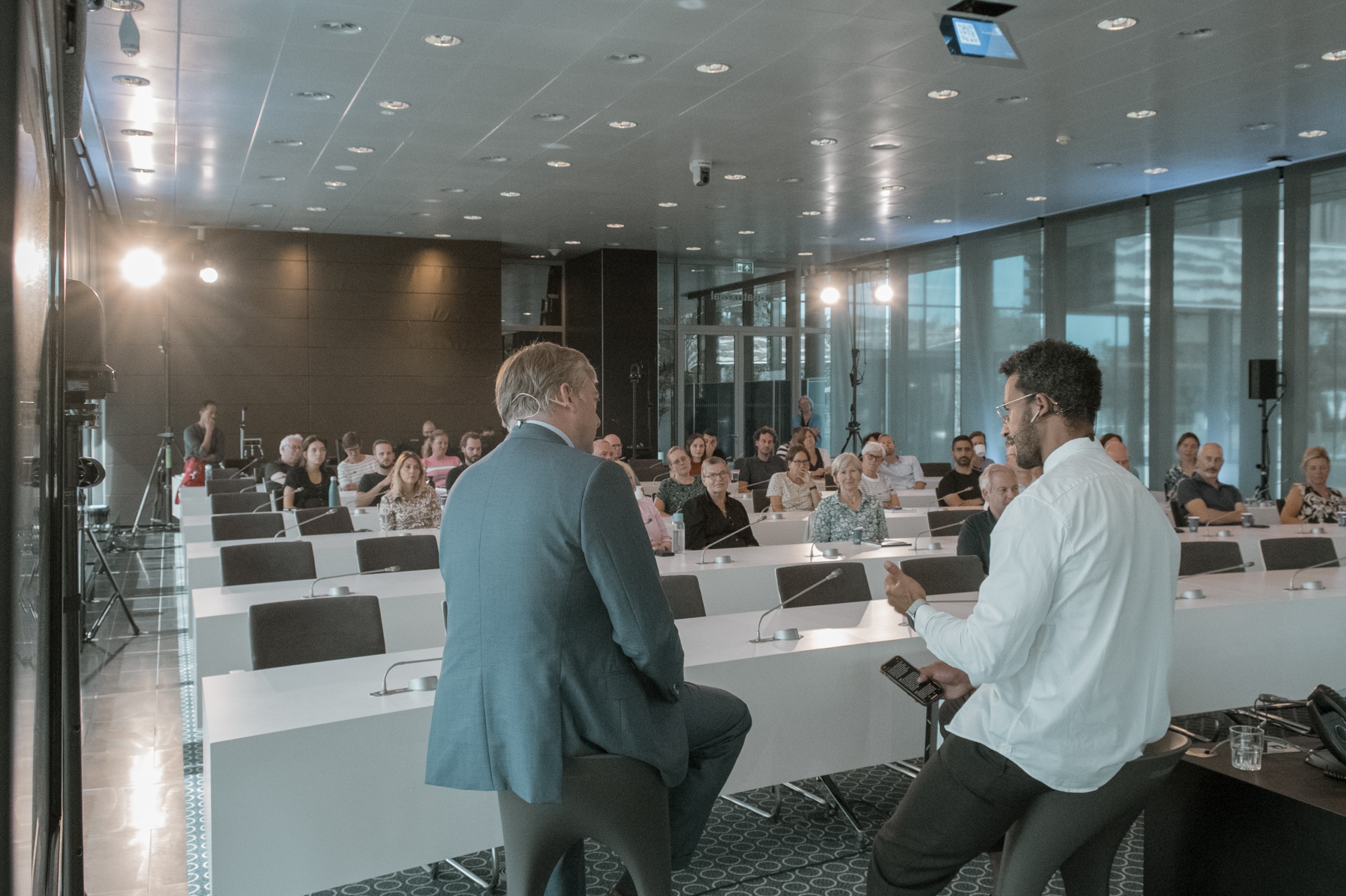
Kick-off at CBS: a podcast-style conversation with Joost Huurman, Head of Office Heerlen.
Participants who completed both measurements; six weeks; self-reported except body measures; no control group. Blood values were within range at the start and barely moved, which is the honest finding, not a headline.
8.7
Office hours
“Personal and in-depth”
8.0
Knowledge and content
“Meant to be applied immediately, with the science behind it”
8.0
Personal development
“Learned that it doesn’t have to be big; it can be simple and it keeps going”
What they asked for, weekly live group sessions and a simpler app, is built into the programme as it runs today.
07
Developed with
| Organisation | What | Year |
|---|---|---|
| CBS | Vitality pilot for a directorate: measured, six weeks, results above. Endorsed by the board. | 2023 |
| Philips Domestic Appliances | Developed The Food Academy: an educational health platform for Philips Kitchen Appliances that teaches consumers a healthy lifestyle through rhythm, food, movement and rest. In-app, with a library of videos and articles. | 2022 |
| Maxion Wheels | Staff vitality and canteen renewal. Endorsed by the board. | 2016 |
| Máxima MC | One year as project adviser on primary prevention: a completely updated and renewed menu cycle, patient communication and training of the nutrition assistants. Endorsed by the board. | 2014–15 |
Our goal is to act on how needs of companies can meet personal desires.
08
Packages
Four ways in. One programme.
An organisation buys a package, not seats. Fixed price, travel included, no discounts. Up to 60 participants per cohort; below that ceiling the number does not change the price. Cohorts start in waves (February, May/June, September/October), so the next start date is always known.
| SME seats | Basic | Middle | Premium | |
|---|---|---|---|---|
| For | Companies up to ±50 staff | One organisation, up to 60 | One organisation, up to 60 | One organisation, 120–300 |
| Live Tuesday hour | Shared across the wave | Shared across the wave | Closed, your organisation only | Closed, per cohort |
| Kick-off and kick-out | Panel kick-off; joint kick-out | Your own, live on site | Your own, live on site | Your own, live, per cohort |
| Reports | Individual report | Individual + group report | Individual + extended group report with recommendations | + annual measurement, linked to your absence and engagement data |
| The human layer | — | — | 1:1 for those the data points to; personal note in week 5; Food session on site | + voice message from Dr. Ludidi; Private+ for the management team |
| Organisation | — | — | Works-council session in week 7; leadership follow-up after four weeks | + leadership track; shift-work version where needed |
| Price, excl. VAT | €595 per seat, min. 5 | From €25,000 | From €45,000 | On request |
Extra cohort of up to 60: on request. Individual blood profiling: optional, opt-in, results to the participant only.
09
Privacy and trust
What your organisation sees, and what it never sees.
Your organisation sees
· Group results only
· The sponsor does not attend the weekly sessions
· Anonymous sharing in sessions is opt-in
· Evening reflections are private
How data is handled
· Personal data stored separately from names, encrypted
· Only Dr. Ludidi and the coach have access
· Participants can request their own data
· A data processing agreement is part of the contract; any AI-assisted processing is disclosed in it
This is prevention, not treatment. A confidential referral route to the company doctor or HR is agreed before we start.
10
Dr. Ludidi
Dr. Samefko Ludidi
Dr. Samefko Ludidi: PhD in gastroenterology (Maastricht), MSc nutrition scientist, BSc human movement scientist. Bestselling author and private coach. Chief Science Officer at The Longevity Store.
11
Questions
12 · Next step
The next step is a 30-minute call.
Choose the scope, settle the open points, pick a start date in the next wave.

Evidence-based coaching, books, and tools to help you reclaim your health and happiness.
© 2026 Dr. Ludidi, all rights reserved